
As your business grows, marketing often becomes too demanding to manage alongside daily operations. You may need better search visibility, consistent content, paid advertising, a stronger website, and a reliable way to measure results.
That raises an important question: should you build an in-house marketing team or hire a digital marketing agency?
In-house marketing can suit businesses with consistent workloads and a need for close daily involvement. Agency marketing can suit businesses that need specialist skills or additional capacity without recruiting a complete team. A hybrid model combines internal ownership with external expertise.
The best investment depends on your business goals, total budget, workload, existing skills, and ability to manage marketing effectively. This guide explains the costs, advantages, limitations, and decision factors behind each approach.
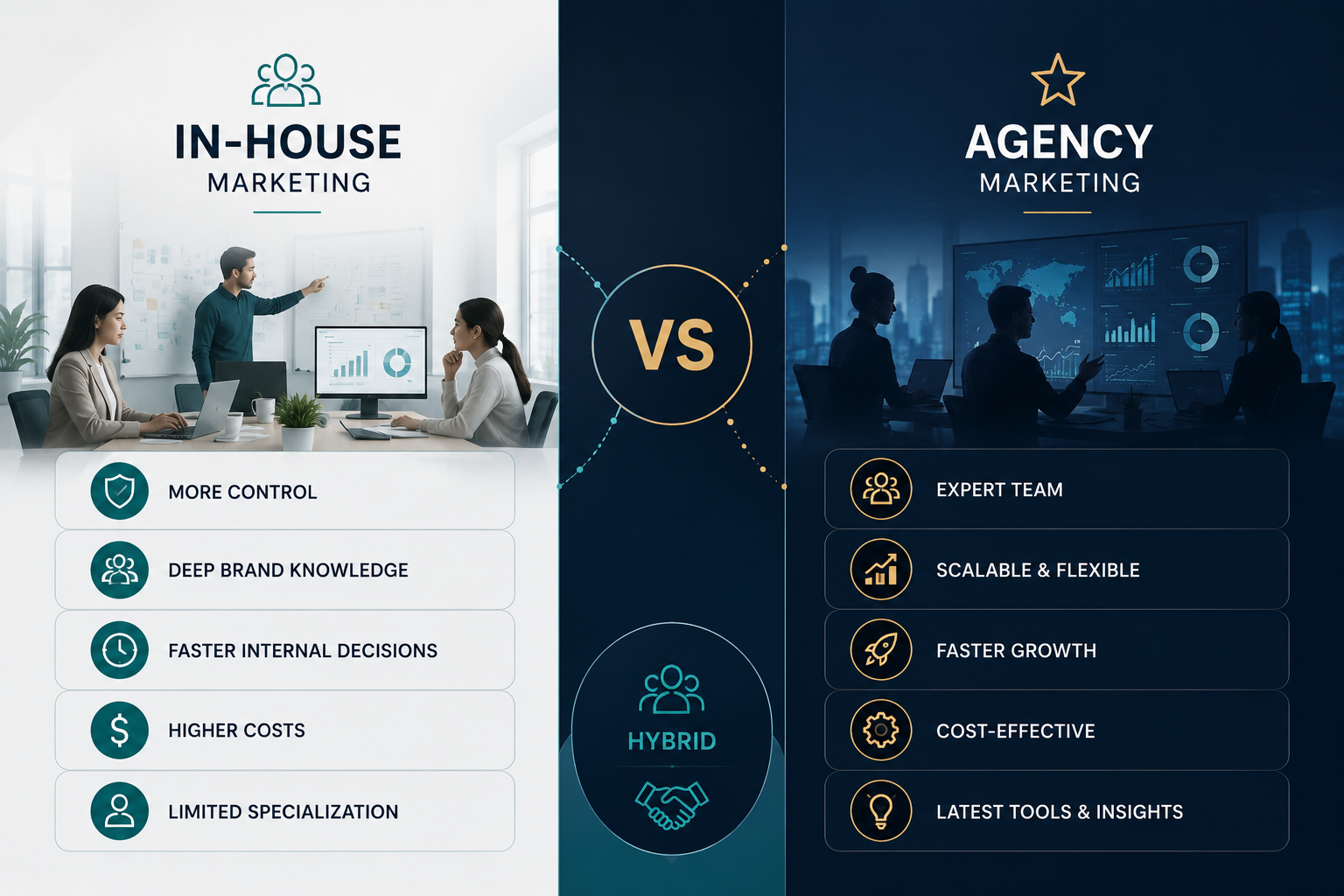
What Is the Difference Between In-House and Agency Marketing?
In-House Marketing
In-house marketing means employing people within your business to plan, execute, and manage marketing activities. Your team might include one marketing manager or several specialists responsible for content, design, SEO, advertising, and website improvements.
These employees work within your organisation and can develop a detailed understanding of your products, customers, brand, and sales process. However, the range of services they can deliver depends on their skills and available time.
Agency Marketing
Agency marketing means hiring an external company to deliver agreed marketing services. These may include search engine optimisation, paid advertising, social media content, creative production, or website development.
An agency provides access to expertise within a defined scope. Its team normally serves multiple clients, so businesses should clarify who will work on their account, how much capacity is included, and how priorities will be handled.
Hybrid Marketing
A hybrid marketing model combines an internal marketing lead or team with external specialists.
For example, an internal manager might own positioning, budgets, and approvals while an agency manages SEO, paid campaigns, and website improvements. This arrangement can work well when responsibilities are clear and both teams share the same business objectives.
In-House vs Agency Marketing: Quick Comparison
| Factor | In-house marketing | Agency marketing |
|---|---|---|
| Brand understanding | Close access to internal knowledge and customers | Requires onboarding and regular business updates |
| Specialist skills | Limited to the team hired and any external support | Depends on the agency's expertise and contracted scope |
| Cost structure | Salaries, recruitment, tools, and operating costs | Retainer or project fees, plus agreed additional costs |
| Daily availability | Employees have dedicated working hours | Availability depends on account capacity and service agreements |
| Control | Direct management and prioritisation | Managed through briefs, approvals, scope, and reporting |
| Scaling | May require hiring or contractors | May require expanded scope and additional fees |
| Main challenge | Recruiting, retaining, and managing suitable talent | Finding the right partner and maintaining alignment |
| Strong fit | Consistent workloads needing close business involvement | Specialist needs or capacity gaps across defined activities |
Neither option automatically produces better results. The quality of the people, strategy, execution, and management matters more than the label.
Comparing In-House and Agency Marketing Costs
A common mistake is comparing one employee's salary with an agency retainer without checking what each option actually delivers.
A marketing manager may coordinate strategy and campaigns but still need help with design, development, video production, or technical SEO. An agency retainer may also exclude some of those services.
To make a fair comparison, define the workload first: channels, campaign volume, content requirements, production needs, reporting, and expected turnaround times.
The True Cost of an In-House Marketing Team
In-house marketing costs extend beyond salaries. Depending on your business and employment arrangements, they can include recruitment, employer contributions such as Employees' Provident Fund (EPF) contributions, benefits, equipment, software, training, and external contractors.
Management time also matters. Someone must set priorities, review work, support professional development, and coordinate marketing with sales.
A practical calculation is:
Avoid assuming that every business needs a large department. A capable generalist supported by contractors may be sufficient for a focused marketing programme.
The True Cost of a Marketing Agency
Marketing agency costs depend on the scope, specialist involvement, production requirements, and reporting expectations.
A monthly fee might cover campaign management while excluding advertising spend, website projects, photography, video shoots, premium assets, or additional revisions.
Use this calculation:
Your business will still need someone to provide information, approve work, and communicate changes in priorities.
Compare Equivalent Scope
Ask both options to support the same requirements. For example, a business may need Google Ads management, SEO improvements, monthly content, landing page updates, and performance reporting.
Compare whether each option can deliver that scope, how much capacity is available, and which tasks require extra spending. For Indian businesses, prepare the comparison in rupees and state whether applicable taxes are included.
Keep advertising spend separate from staffing or agency fees in both calculations. This makes the operational costs easier to compare.
Advantages and Disadvantages of In-House Marketing
Strong Brand and Product Knowledge
An internal team can work closely with founders, sales teams, customer support, and product specialists. This access helps marketers understand customer objections, product changes, and brand priorities.
It can be particularly valuable when accurate content requires detailed business knowledge or frequent input from internal experts.
Direct Access and Daily Coordination
In-house employees can participate in daily discussions and respond to internal requirements within their working capacity.
This can support product launches, customer communications, events, and ongoing content production. However, quick access does not mean unlimited output: priorities and workloads still need management.
Long-Term Capability Building
An internal team can build reusable processes, customer knowledge, and marketing skills within the business. With suitable leadership and documentation, that knowledge can support future growth.
The investment works best when there is enough sustained work to use the team's capacity effectively.
Recruitment and Skill Gaps
Hiring suitable marketers takes effort, and one person may not have deep expertise across every channel.
A strong content marketer may need support with conversion tracking. An experienced advertising specialist may need designers and developers to improve landing pages.
Recruit for your most important needs rather than expecting one employee to perform every role equally well.
Dependence on Key Employees
Small teams can become vulnerable when a key employee leaves or is unavailable. Documentation, shared access, and backup support help reduce disruption.
Advantages and Disadvantages of Agency Marketing
Access to Specialist Skills
An agency can provide several disciplines within one working relationship. Depending on its team and scope, this may include paid advertising management, SEO, content, design, and development.
Before signing, confirm which specialists will support your account and which activities are included. A broad service list does not guarantee equal depth in every area. For search work specifically, Google's own guidance on hiring an SEO provider lists useful questions to ask before you commit.
Established Processes
An agency may already have workflows for planning, production, campaign reviews, and reporting. These processes can reduce the need to build everything internally.
However, onboarding still requires time. Account access, tracking checks, business research, creative approvals, and website readiness can all affect launch schedules.
External Perspective
An agency can bring ideas and experience from other projects. This may help identify opportunities or challenge assumptions that an internal team has become used to.
Those ideas still need testing against your audience, margins, sales cycle, and business constraints. Results from another client are not a guarantee of results for your business.
Shared Capacity and Scope Limits
Agency teams normally work across several accounts. Turnaround times, revision limits, and urgent requests should therefore be discussed before work begins.
Expanding activity may require a larger retainer or a separate project. Clarify the process for approving additional costs.
Business Context and Communication Gaps
An agency depends on your input to understand customer feedback, stock availability, pricing changes, and sales performance.
Weak communication can lead to campaigns that attract enquiries your business cannot serve. A regular review process helps keep marketing aligned with operations.
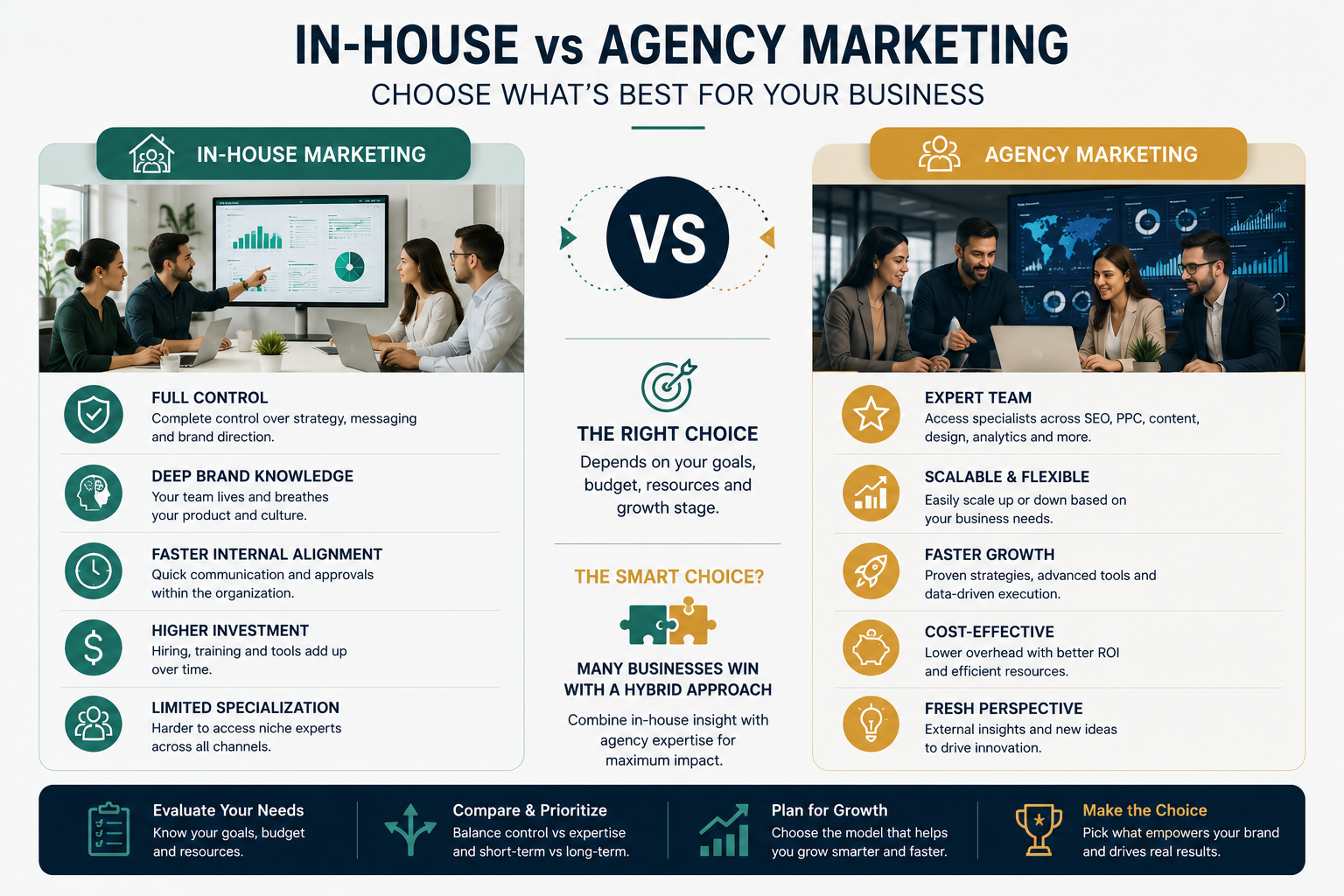
When Should You Build an In-House Marketing Team?
An in-house team can make sense when you have enough ongoing work to justify dedicated employees and the leadership capacity to manage them.
It may be suitable when marketing requires daily access to internal experts, frequent product updates, detailed customer knowledge, or substantial on-site coordination.
There is no universal revenue threshold for hiring internally. A smaller business with a demanding content workload may benefit from an internal marketer, while a larger business may continue using agencies for specialist projects.
Start by identifying which responsibilities need sustained internal attention. Build around those needs rather than hiring a complete department immediately.
When Should You Hire a Digital Marketing Agency?
An agency can be suitable when you need capabilities that your current team cannot provide, or when recruiting several specialists would be difficult to justify.
For example, you may need help improving search visibility, managing advertising, creating campaign assets, and updating your website. An agency can coordinate these activities if its scope and expertise match your requirements.
Agency support can also suit a defined project, such as a website redesign or campaign launch. Set objectives, deliverables, review milestones, and responsibilities before work begins.
An agency partnership still requires internal ownership. Assign someone who can approve work, share business information, and connect marketing activity with sales outcomes.
How a Hybrid Marketing Model Works
A hybrid model separates responsibilities according to where they can be handled most effectively.
The internal team may own customer insights, brand direction, budgets, and approvals. The agency may handle specialist execution, technical work, and additional production capacity.
For example, an internal marketing manager could plan campaigns and collect sales feedback while an agency manages SEO, advertising, and website design and development.
The main risk is overlapping ownership. Agree who sets priorities, who approves spending, who implements changes, and who reports results. Shared goals and a clear workflow help both teams work together.
How to Choose the Right Marketing Model
Identify the Business Outcome
Start with the result you need: qualified enquiries, online purchases, booked appointments, stronger visibility, or improved conversion rates.
Then work backwards to the activities and skills required. This prevents hiring or outsourcing based only on a general feeling that you need "more marketing."
Assess Your Existing Capabilities
Review what your team can already do well and where work is delayed or missing.
If your brand knowledge and content production are strong but advertising performance is weak, specialist agency support may be enough. If daily coordination is the main problem, an internal marketing lead may provide more value.
Evaluate Workload and Management Time
Consider both recurring work and occasional projects. Sustained daily responsibilities may justify internal capacity, while specialist or intermittent work may suit outsourcing.
Be realistic about who will manage the arrangement. Both employees and agencies need direction, decisions, and feedback.
Define Ownership and Reporting
Your business should retain appropriate ownership and administrative access to its website, advertising accounts, analytics, and marketing assets.
Agree on access permissions, reporting frequency, documentation, and handover arrangements. These expectations should be clear before the relationship begins. Platforms such as Google Ads offer separate user access levels, so you can keep admin control while giving employees or agencies the permissions they need.
Measure Business Results
Evaluate marketing using outcomes that matter to your business. Depending on your model, these may include qualified leads, conversion rates, cost per acquired customer, repeat purchases, and revenue contribution where attribution is reliable. In Google Analytics 4, your attribution model and lookback window settings affect how credit for each conversion is assigned, so agree on them before comparing results.
Traffic, reach, and engagement can help diagnose performance, but they should be interpreted alongside customer and sales outcomes.
Allow suitable time for evaluation. Different activities have different learning periods, and results also depend on your offer, website, sales follow-up, and customer experience.
Where a Fractional CMO Fits
A fractional Chief Marketing Officer provides senior marketing leadership on a part-time or contracted basis. Their responsibilities may include positioning, budget allocation, planning, and coordination across internal teams and external providers.
This differs from simply outsourcing campaign execution. Businesses should clarify whether an engagement includes senior leadership, delivery, or both.
A fractional CMO may be useful when a business needs experienced direction but does not require a full-time executive.
Marketing Support from RASS E-Vision
RASS E-Vision is a Mumbai-based digital marketing agency offering support across SEO, paid advertising, website development, content, and video production.
Depending on your requirements, agency support can complement an existing team or provide execution across an agreed set of services. The starting point should be your business goals, current challenges, and available budget.
If you are evaluating in-house vs agency marketing, discuss your marketing requirements with RASS E-Vision to explore the scope of support your business needs.
Discuss your requirements