
Hiring a digital marketing agency is an important investment. The right partner can help your business reach relevant customers, generate qualified leads, and improve conversions. A poor fit can lead to unclear reporting, wasted spending, and campaigns that do not support your goals.
If you are wondering how to choose a digital marketing agency, start by examining its relevant experience, proposed strategy, measurement approach, pricing, and contract terms. A strong pitch is useful, but the evidence behind it matters more.
This guide explains how small and growing businesses can compare agencies, ask better questions, and choose a digital marketing partner with confidence.
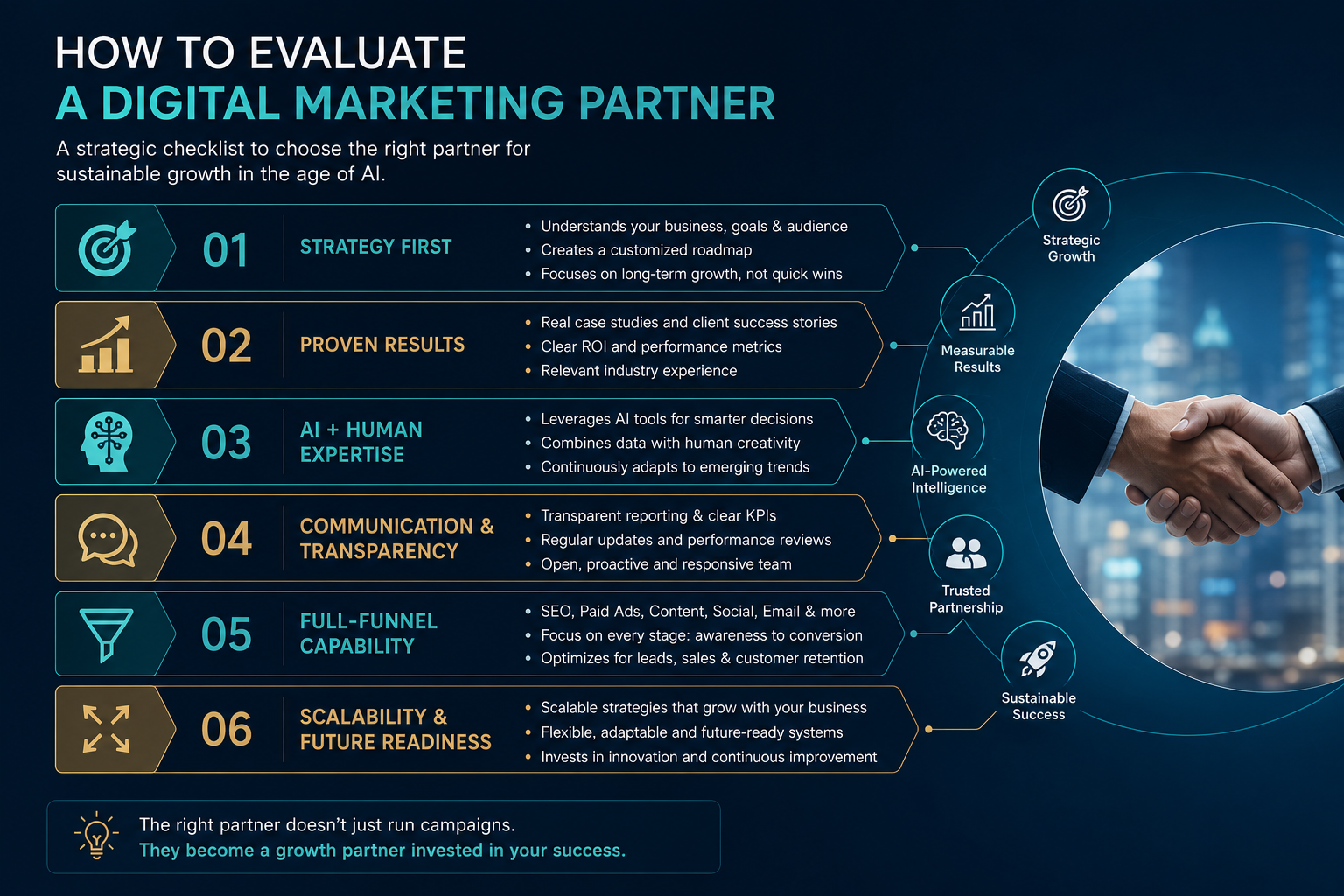
Define Your Business Goals Before Hiring an Agency
Before comparing agencies, identify the business problem you want to solve. Do you need more enquiries, better-quality leads, more online sales, stronger local visibility, or a website that converts more visitors?
"Grow our business" is a starting point, but it is too broad to guide a campaign. A clearer brief might be: "We want more qualified enquiries for our website development service from business owners in Mumbai."
Share your current marketing activity, target customers, service areas, sales process, and available budget. Include known challenges, such as slow lead follow-up or a low enquiry-to-sale conversion rate.
The right agency should help refine your objectives and explain which outcomes marketing can influence. It should also identify changes your business needs to make, such as improving the offer, website, or sales response.
Check Relevant Experience and Verified Case Studies
Look for experience with businesses that have similar customers, sales cycles, or commercial challenges. An agency does not always need to have worked in your exact industry, but it should explain how its experience applies to your situation.
For example, generating enquiries for a local coaching class differs from selling products through an online store. The audience, campaign messaging, conversion tracking, and sales process require different decisions.
What a Useful Case Study Should Include
A useful case study explains the client's starting position, the work completed, the campaign duration, and the outcome. For paid campaigns, ask about advertising spend and whether the figures include agency fees.
If an agency reports a large increase in leads, ask how it defined a lead and whether lead quality improved. More form submissions do not necessarily mean more suitable customers.
Request a client reference where available, with the client's permission. Ask about communication, deadlines, problem-solving, and whether the agency delivered the agreed scope.
Confidentiality can limit what an agency shares. An anonymised example or a walkthrough of its process can still be useful, provided the limitations are clear.
Evaluate the Strategy Behind the Proposal
A good agency should understand your business before recommending a channel mix. Its discovery process should explore your customers, competitors, pricing, margins, service capacity, and sales cycle.
The proposal should explain what it plans to do, why those actions matter, and how it will measure progress. A list of posts, keywords, or advertisements is a deliverables list; you also need the reasoning behind those deliverables.
Standard workflows can improve consistency. However, the targeting, messaging, budget allocation, and priorities should reflect your business.
Ask for an Initial Action Plan
Ask what the agency would prioritise during the first few months. This might include an audit, tracking checks, website improvements, campaign launches, and testing.
The plan should identify dependencies. For example, paid advertising may need a clearer landing page before launch, while an SEO campaign may need technical fixes before new content.
You should understand which actions come first, what your team must provide, and when performance will be reviewed.
Compare Full-Service and Specialist Agencies
Choosing a digital marketing agency also means deciding how much support you need.
A specialist agency can suit a clearly defined requirement, such as technical SEO, Google Ads management, or video production. A full-service agency can suit a business that needs several channels coordinated under one strategy.
Neither model is automatically better. Compare the agency's capabilities with your goals, budget, and internal resources. If you are still deciding whether to outsource at all, weigh the trade-offs of in-house vs agency marketing first.
If your priority is organic visibility, ask about SEO services, technical improvements, and useful content. If you need paid customer acquisition, examine the agency's performance marketing services, creative testing, and conversion tracking.
If visitors reach your website but rarely enquire, website design and conversion improvements may be part of the solution. Businesses investing in brand awareness and audience engagement should also assess social media management and creative production.
Ask who performs each service and whether work is handled internally or by external specialists. What matters is knowing who is responsible and how quality is maintained.
Look Beyond Vanity Metrics and Understand Business Results
Impressions, clicks, engagement, and followers can help explain campaign performance. However, they should be interpreted alongside the campaign's purpose and relevant business outcomes.
An awareness campaign may focus on reaching the right audience. A lead-generation campaign needs to consider enquiries, lead quality, sales opportunities, and customer acquisition.
Cost Per Lead and Customer Acquisition Cost
Cost per lead, or CPL, measures the cost of generating a lead. Ask whether the reported figure includes advertising spend alone or other campaign costs.
Customer acquisition cost, or CAC, measures the cost of acquiring a customer. Agree on the calculation, including which marketing and sales costs are included and which period is being measured.
A campaign with a higher CPL can still be more valuable if those leads are more likely to become profitable customers.
Return on Ad Spend and Marketing ROI
Return on ad spend, or ROAS, compares revenue attributed to advertising with advertising spend. For example, ₹1,00,000 in attributed revenue from ₹25,000 in ad spend represents a ROAS of 4.
That does not mean the business earned four times its investment in profit. Product costs, agency fees, returns, and other expenses affect profitability. Google's Target ROAS documentation explains how conversion values support value-based bidding.
Marketing ROI should use a clearly agreed calculation that considers relevant costs and returns. Ask how the agency accounts for margins and how it connects campaign activity to business results. Our guide on how to measure digital marketing ROI covers this in more detail.
Lead Quality and Sales Conversion
For service businesses, ask about qualified enquiries, booked meetings, proposals, and sales. Agree on what makes a lead suitable, such as location, service requirement, budget, or purchase readiness.
Marketing and sales should review these results together. Weak sales can reflect poor targeting, but they can also result from slow follow-up, an unclear offer, pricing, or limited capacity.
Check Conversion Tracking and Revenue Reporting
Ask how the agency will measure calls, form submissions, purchases, bookings, and other valuable actions. It should explain which actions are tracked and how it checks that the tracking works.
For businesses with an offline sales process, a CRM or a consistently maintained lead record can help connect enquiries with later outcomes. Where appropriate, ask whether qualified-lead or sale data can be fed back into advertising platforms through offline conversion imports.
Attribution has limits. Privacy settings, cross-device journeys, and offline interactions can make exact revenue attribution difficult. A transparent agency explains these limitations and compares platform reports with business records.
Request a sample report. It should show the reporting period, spend, relevant outcomes, interpretation, and next actions. A dashboard is useful only when the information helps you make decisions.
Understand Agency Fees and Contract Terms
When comparing digital marketing agency pricing, review the complete cost rather than the headline monthly fee.
Ask which charges cover agency work and which cover advertising, content production, website development, software, or other services. Confirm whether applicable taxes are included.
A lower fee can become expensive if important work is excluded or frequently charged separately. A higher fee should be supported by a clear scope and relevant expertise.
Confirm Deliverables and Exclusions
The written scope should explain the services, output, responsibilities, revision limits, and approval process. It should also distinguish initial setup work from ongoing management.
For SEO, understand whether technical fixes, content creation, and implementation are included. For social media, clarify whether the price covers strategy, design, captions, scheduling, community management, and shoots. For paid ads, confirm whether creative production and landing-page work are included.
Review Commitment and Exit Terms
Before signing, check the minimum commitment, payment schedule, notice period, cancellation conditions, and handover process.
Ask how additional work is quoted and approved. If the scope changes, both sides should know how the change affects fees and timelines.
Protect Account Ownership and Access
Your business should retain appropriate ownership or administrator control of essential digital assets, including its domain, website, advertising accounts, analytics, and business profiles.
Where supported, give the agency role-based access to perform its work. Avoid relying on one shared login for every user.
Clarify ownership of creative files, landing pages, reports, and custom code. Third-party software, stock assets, and licensed materials may have separate terms.
The contract should explain how access and agreed assets will be handed over when the engagement ends. Establish these arrangements before work begins.
Meet the Team and Assess Communication
The person selling the service may not be the person managing your account. Ask who will lead the work, who will execute it, and how issues will be escalated.
Agree on communication channels, meeting frequency, approval deadlines, and expected response times. Your team should also know what it must provide to keep the work moving.
When results underperform, the agency should explain what happened, what the data suggests, and what it proposes to change. You need a clear response and a review plan, while recognising that business outcomes depend on factors beyond agency execution alone.
The agency's own marketing can offer supporting evidence of its capabilities. However, judge its website and social channels alongside client work, references, and the team responsible for delivery.
Questions to Ask a Digital Marketing Agency
Before hiring an agency, ask these questions and compare the answers across your shortlist.
| Question | What a useful answer should explain |
|---|---|
| What experience is relevant to our business? | Comparable work and why it applies |
| What would you prioritise first? | An initial plan, dependencies, and rationale |
| How will you define a qualified lead? | Criteria agreed with your sales team |
| Which results will you report? | Metrics connected to your objectives |
| How will you verify conversion tracking? | Setup, testing, and ongoing checks |
| Who will manage our account? | Named responsibilities and escalation process |
| What does the fee include? | Scope, exclusions, and additional charges |
| Who owns our accounts and assets? | Access, ownership, and handover terms |
| What happens if performance is weak? | Investigation, proposed changes, and review |
| How can we end the engagement? | Notice, cancellation, and transition terms |
Digital Marketing Agency Red Flags
Be cautious when an agency guarantees first-place Google rankings, fixed sales results without understanding your business, or outcomes it cannot substantiate.
Other concerns include refusing to explain the work, hiding charges, presenting results without context, denying appropriate account access, or pressuring you to sign before reviewing the scope.
A standard package is not automatically a problem. The concern is whether the agency can explain its suitability and adapt important decisions to your needs.
Similarly, a long-term engagement may be reasonable for some work. You should still understand the commitment, milestones, reporting, and exit terms.
Compare Agencies Using a Simple Checklist
Use the same criteria for every shortlisted agency. Record the evidence received and note anything that remains unclear.
| Evaluation area | What to check |
|---|---|
| Business understanding | Clear grasp of your customers, goals, and constraints |
| Relevant experience | Credible examples with meaningful context |
| Strategy | Priorities supported by a clear rationale |
| Measurement | Tracking and reporting suited to your sales process |
| Pricing | Transparent fees, deliverables, and exclusions |
| Delivery | Clear responsibility and communication |
| Ownership | Appropriate access and documented handover |
| Contract | Understandable commitment and cancellation terms |
Resolve unanswered questions before committing. The most suitable digital marketing partner is the one whose capabilities, working process, and commercial terms fit your business.
Frequently Asked Questions
How do I choose a digital marketing agency for my business?
Define your objectives, budget, and required services. Then compare agencies on relevant experience, strategy, measurement, team capability, pricing, and contract terms. Request evidence and meet the people responsible for delivery.
How much does a digital marketing agency cost?
Costs depend on the services, workload, campaign complexity, production needs, and team involved. Request an itemised proposal separating agency fees from advertising spend and other charges.
Should I hire a local digital marketing agency?
A local agency can be convenient for meetings, shoots, and work requiring knowledge of your service area. Remote agencies can also deliver effectively. Compare expertise and working arrangements rather than choosing on location alone. If you are based in Mumbai's western suburbs, see our guide to choosing a digital marketing agency in Andheri.
Is a full-service agency better than a specialist?
A full-service agency can coordinate several marketing activities. A specialist can suit a focused requirement or complement your internal team. Choose the model that matches your priorities and resources.
How long does digital marketing take to show results?
Timelines vary by channel, starting position, competition, budget, and sales cycle. Paid campaigns can generate traffic soon after launch, but profitable performance requires evaluation and optimisation. SEO typically involves a longer development period. Ask for milestones and assumptions rather than guaranteed dates.
What should an agency report each month?
Reports should reflect your goals and explain spend, activity, results, and planned changes. For lead generation, review qualified leads and sales outcomes where available. For online sales, review revenue, advertising efficiency, and profitability context.
Can an agency guarantee first-place Google rankings?
No agency can guarantee a particular organic Google ranking. Google's own guidance on hiring an SEO makes the same point. Ask for a credible SEO process, relevant evidence, and realistic expectations.
Should my business own its advertising accounts?
Your business should retain appropriate ownership or administrator control where the platform supports it. Give the agency the access it needs and document the handover process.
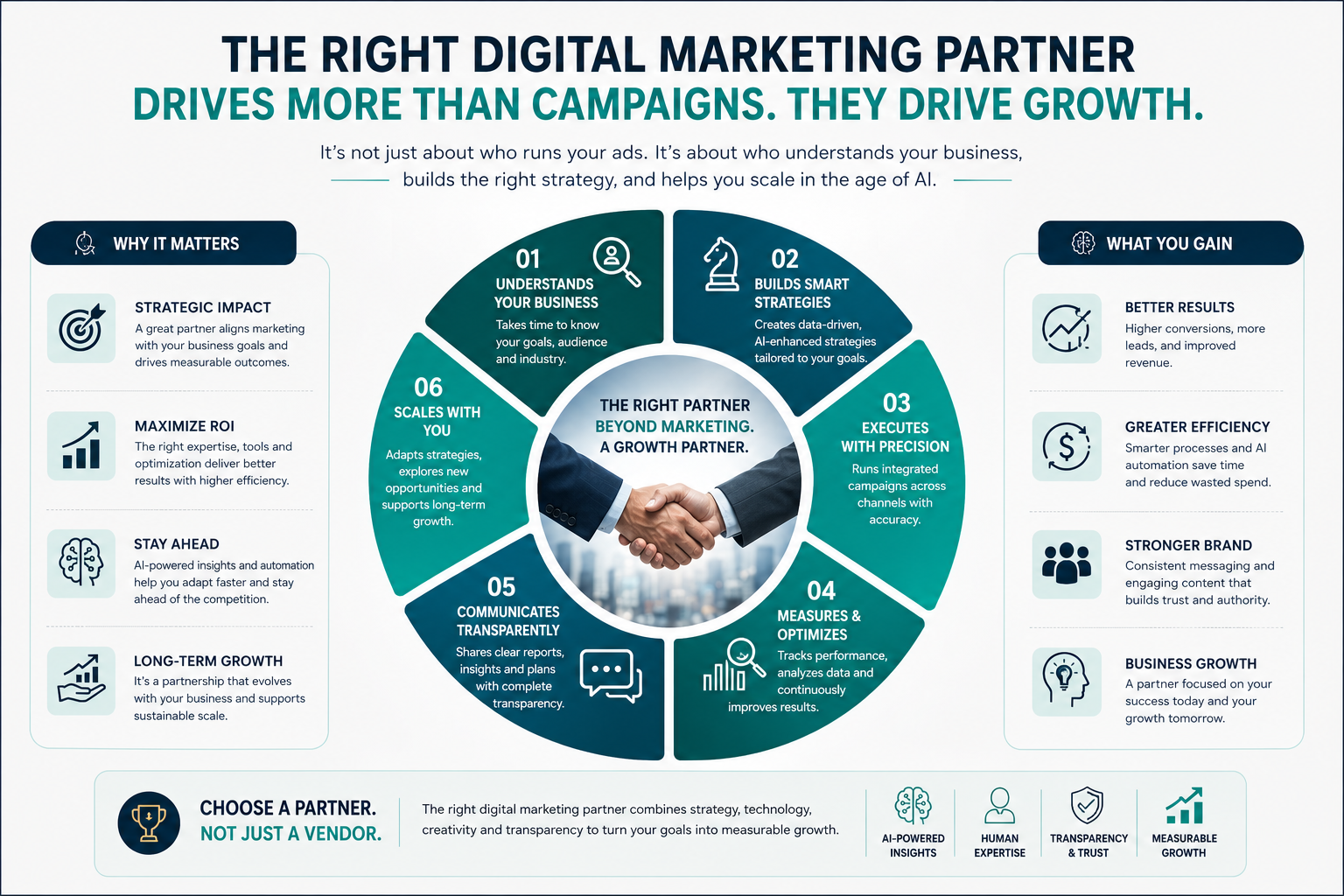
Discuss Your Marketing Requirements with RASS E-Vision
Choosing a digital marketing partner starts with a clear business brief and a careful evaluation of the team delivering the work.
RASS E-Vision provides SEO, paid advertising, website development, social media, and video services for businesses in Mumbai. Share your goals, current challenges, and requirements so we can discuss the support suited to your business.
Contact RASS E-Vision to discuss your marketing requirements.
Discuss your requirements